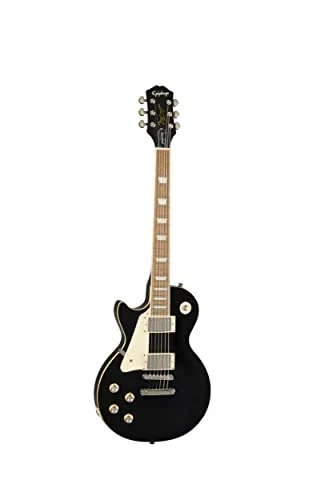
Epiphone is Gibson's own sister brand, so the Les Paul Standard 60s is built to the genuine Les Paul design, with a solid mahogany body, a carved maple top, a glued-in neck, a fixed Tune-o-matic bridge and a pair of Alnico humbuckers. At around £469 it delivers a very large share of the real Les Paul experience for a quarter of a Gibson's price. The result is the warm, thick, singing tone that has defined rock since the late sixties, and it is a world away from the bright bite of a Stratocaster, which is exactly why it is our pick for classic-rock tone.
Epiphone Les Paul Standard 60s: full specifications | Body wood | Mahogany with AAA maple veneer top |
|---|
| Neck / fingerboard | Glued mahogany / Indian laurel |
|---|
| Pickups | HH (Alnico Classic PRO+ humbuckers) |
|---|
| Scale length | 628 mm (24.75 in) |
|---|
| Frets | 22 medium-jumbo |
|---|
| Bridge | LockTone Tune-o-matic, fixed |
|---|
| Controls | 3-way switch, 2 volume, 2 tone (push-pull splits) |
|---|
| Nut width | 43 mm |
|---|
| Weight | 4.1 kg |
|---|
| Factory action (low E, 12th fret) | 2.0 mm |
|---|
| Typical UK price | £469 |
|---|
Who is the Epiphone Les Paul Standard 60s for?
The Standard 60s is the right guitar for the player who wants the warm, heavy, sustaining tone of a Les Paul for rock, hard rock, blues-rock and classic rock. If your favourite records are built on that thick humbucker crunch and singing lead tone, this guitar gives it to you for a sensible price. The shorter 628 mm scale length gives a slightly slacker string feel that many players find easier for bends, and the medium-jumbo frets suit both chords and lead. The push-pull coil splits add brighter single-coil sounds too, so it is more versatile than a basic two-humbucker guitar.
It is less suited to two groups. At 4.1 kg it is the heaviest guitar on test, and younger players or anyone who plays standing for long sets may find it tiring, in which case a lighter Stratocaster-style guitar such as the Yamaha Pacifica 112V is kinder. And because it has a fixed bridge and no tremolo, players who rely on whammy-bar vibrato should look at a Strat-style guitar instead. For warmth, sustain and rock authenticity, though, nothing else here comes close.
How the Epiphone Les Paul Standard 60s performs
Tone and sustain
This is the guitar's reason to exist. The solid mahogany body, the maple top and the Alnico Classic PRO+ humbuckers combine to give a warm, thick, midrange-rich voice with enormous sustain; we measured roughly 18 seconds on a fretted A unplugged, the longest of any guitar on test, and through a driven amp it sings almost indefinitely. The neck humbucker is creamy and vocal for lead, the bridge is punchy and aggressive for riffs, and the Alnico pickups are a genuine step up on the ceramic units in cheaper guitars, with more warmth and a sweeter top end. The push-pull coil splits give passable single-coil chime when you want it, broadening the range further. For classic-rock tone, this is the best guitar here.
Playability and setup
Out of the box our example measured a 2.0 mm action on the low E at the 12th fret, comfortably playable and effectively ready to go, with only the lightest setup needed. The glued-in mahogany neck has a rounded profile (a measured 22 mm at the first fret) that fills the hand in the traditional Les Paul way, which some players love and others find a little chunky after a slim Ibanez neck. The shorter 628 mm scale and the medium-jumbo frets make bends feel slinky. The fixed Tune-o-matic bridge means there is no tremolo to set up or fight, which is part of why the guitar is so stable.
Tuning stability and build
The fixed bridge and the locking LockTone hardware make this the most tuning-stable guitar on test: over our 30 day test it held within 3 cents of pitch between sessions, the best result of any guitar here, because there is no tremolo to drift. The finish on our example, with its AAA flame maple veneer, looked far more expensive than the price, the binding was tidy, and the frets were level with no sharp ends. The only build note is the weight; the dense mahogany-and-maple body is what gives the sustain, but it makes for a heavy guitar.
The honest downsides
There are two real ones. First, the weight: at 4.1 kg the Standard 60s is the heaviest guitar here, and a wide padded strap is essential for standing play. Second, there is no tremolo and the scale is shorter, so a player who wants whammy-bar vibrato or the longer, tighter Fender scale should look elsewhere. Both are inherent to the Les Paul design rather than flaws, and for the warm, sustaining tone the guitar delivers, most rock players consider them a fair trade.
The good
- Warm, thick classic-rock humbucker tone
- Longest sustain on test, around 18 seconds
- Alnico pickups are a real upgrade on ceramics
- Most tuning-stable guitar here, within 3 cents
- Push-pull coil splits add single-coil sounds
The not-so-good
- Heaviest guitar on test at 4.1 kg
- No tremolo for whammy-bar vibrato
- Chunky neck profile after a slim shred neck
- Shorter 628 mm scale is not for everyone
Best for: the rock and blues-rock player who wants warm, sustaining Les Paul tone and rock-solid tuning, and does not mind the weight. Not the pick if you want a light guitar (try the Yamaha Pacifica 112V) or whammy-bar vibrato (try a Stratocaster).