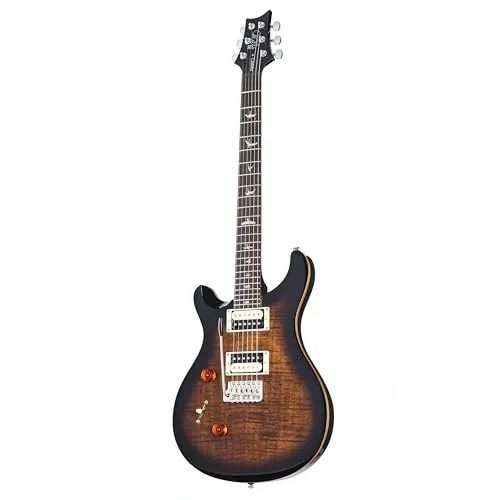
PRS SE Custom 24: full specifications | Body wood | Mahogany with maple top |
|---|
| Neck / fingerboard | Glued maple / rosewood, Pattern Thin |
|---|
| Pickups | HH (TCI-tuned 85/15 "S" humbuckers) |
|---|
| Scale length | 635 mm (25 in) |
|---|
| Frets | 24 jumbo |
|---|
| Bridge | PRS patented tremolo |
|---|
| Controls | 3-way toggle, 1 volume (push-pull split), 1 tone |
|---|
| Nut width | 42 mm |
|---|
| Weight | 3.4 kg |
|---|
| Factory action (low E, 12th fret) | 1.9 mm |
|---|
| Typical UK price | £899 |
|---|
Who is the PRS SE Custom 24 for?
The SE Custom 24 is the right guitar for the player who wants a single instrument that can do everything to a high standard. If you play across styles, clean funk one minute, crunchy rock the next, tight metal the minute after, this is the guitar that handles all of it without compromise. The 24 frets give you the full range for lead, the 635 mm scale length sits between the Fender 648 mm and the Gibson-style 628 mm so it feels familiar to players from either camp, and the coil-splitting humbuckers cover both warm and bright tones. It is also a guitar that looks and feels far more expensive than it is, which makes it a satisfying long-term keeper.
It is less suited to two groups. Complete beginners do not need everything the Custom 24 offers, and at around £899 it is a lot to spend before you are sure you will stick with the instrument; the Yamaha Pacifica 112V offers much of the same versatility for a third of the price and is the more sensible first guitar. And players who want the absolute warmth and weight of a true Les Paul may prefer the Epiphone Les Paul Standard 60s, which leans harder into that thick, heavy tone. For do-it-all versatility, though, the PRS is the best guitar here.
How the PRS SE Custom 24 performs
Tone and versatility
This is the most versatile guitar on test, and the cleverness is in the pickups. The 85/15 "S" humbuckers are voiced to be clear and balanced rather than dark, so with the coils together they deliver full, articulate humbucker tone for rock and metal, neither muddy nor harsh. Pull up the volume knob to split them and you get a believable single-coil chime for funk, clean work and country, far closer to a real single-coil than most coil-splits manage. The result is a guitar that genuinely covers warm rock, tight high-gain and bright cleans, all convincingly. We measured the unplugged sustain on a fretted A at around 17 seconds, helped by the mahogany body and the set neck, and through any amp it stays articulate and balanced across the whole range.
Playability and setup
The playability is the best on test alongside the Yamaha. Out of the box our example arrived with a 1.9 mm action on the low E at the 12th fret, perfectly level jumbo frets with mirror-polished ends, and no buzz anywhere on the 24 frets. The Pattern Thin neck (a measured 20 mm deep at the first fret) is fast without feeling skinny, and the wide-thin profile suits both chords and lead. The 635 mm scale gives a string feel between a Fender and a Gibson, which most players find comfortable from either background. Everything about how the guitar plays feels considered and refined.
Tuning stability and build
The PRS patented tremolo is the best vibrato system on test by some margin: it returns to pitch reliably even after fairly aggressive use, and over our 30 day test the guitar held within 4 cents of pitch between sessions, excellent for a tremolo-equipped instrument. The fit and finish are in a different class from the budget guitars; the figured maple top, the tidy binding and the flawless gloss all look like a far dearer instrument, and the neck-to-body joint is immaculate. This is where the price goes, and it is money you can see and feel.
The honest downsides
There are two, and they are minor. First, the price: at around £899 it is the most expensive guitar here and far more than a beginner needs to spend on a first instrument. Second, the figured-top looks, while gorgeous, can read as a little flashy for players who prefer a plainer, more traditional guitar. Neither is a performance flaw; both simply mean the Custom 24 is a premium, do-everything guitar aimed at the committed player rather than the cautious first-timer.
The good
- Genuinely does it all, from cleans to heavy gain
- The most refined fit, finish and setup on test
- Coil split gives convincing single-coil tones
- Best tremolo on test, holds tuning within 4 cents
- 25 in scale and fast neck feel familiar to all
The not-so-good
- The most expensive guitar on this list
- Flamed-top looks can read as flashy
- More than a complete beginner needs
- Not the absolute warmest for pure Les Paul fans
Best for: the committed player who plays across styles and wants one premium guitar that does everything well. Not the pick if you are a complete beginner on a budget (try the Yamaha Pacifica 112V) or want the warmest, heaviest pure Les Paul tone (try the Epiphone Les Paul Standard 60s).